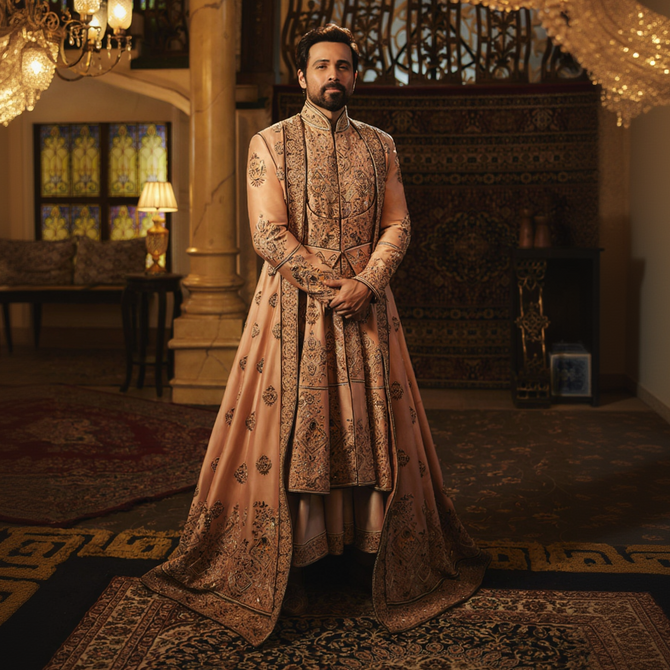

Indo-Western wedding wear is moving beyond the idea of combining an Indian garment with a Western cut. In 2026, the more interesting shift is toward silhouettes that change how a groom moves, layers, photographs, and expresses his personality. From sculptural drapes to convertible layers, the latest designer indo western for men trends are making traditional occasionwear more adaptable without losing its Indian character.
1. Asymmetric Silhouettes That Create Movement
Asymmetric hemlines, angled closures, wrap fronts, and directional panels are giving Indo-Western for men a more architectural character. The appeal is not asymmetry for its own sake. Uneven lines create movement as the wearer walks, dances, or poses, making the outfit appear different from every angle.
2. Tonal Dressing Replaces Loud Contrast
Monochromatic Designer indo western for Groom looks have been picking up ground steadily, and 2026 is where that direction becomes a clear preference rather than an occasional experiment. Ivory, champagne, sage, muted blue, and deeper jewel tones are all showing up within this approach. Staying within one colour family shifts the visual interest onto embroidery, texture, and construction rather than relying on contrast to do the work.
The result tends to look more considered and less busy than outfits built around competing shades.
3. Draping Becomes a Defining Design Element
The stole is no longer necessarily a finishing accessory. Draped panels, diagonal wraps, fluid overlays, and sculptural layers are becoming part of the silhouette itself. This gives Indo-Western outfits for men a softer quality while retaining structured elements underneath. The contrast between fluid fabric and precise tailoring creates a more expressive wedding look.
4. Belts Redefine the Proportion
A belted waist is one of the more distinctive directions emerging in 2026. Placed over a long jacket or sherwani-inspired layer, a belt breaks the vertical line of the garment and creates a clearer waist. It also introduces a contemporary accessory without requiring heavy embroidery or additional layers.
5. Texture Takes Centre Stage
How a fabric feels and catches light has become just as important as what is embroidered onto it. Jacquard, raw silk, velvet, textured weaves, and fabrics with subtle surface irregularities are giving Indo-western outfits men a richness that heavy embellishment used to be responsible for. Velvet in particular is coming back strongly for 2026 wedding dressing, and not just for evening functions. It is showing up across a wider range of celebrations than it traditionally has, which reflects how much the fabric's associations have shifted in recent seasons.
6. Convertible Layers Create Multiple Looks
Detachable capes, removable jackets, convertible collars, and interchangeable outer layers are making designer Indo-Western dresses for men more adaptable. A groom can retain the complete layered look for the ceremony and remove an outer element later for greater ease. This makes one carefully designed ensemble capable of changing character during a long wedding celebration.
7. Structured Bandhgala Proportions Meet Indo-Western Styling
Sharper shoulders, defined collars, shaped waists, and cleaner proportions are bringing the precision of formal tailoring into designer Indo-Western silhouettes. The result can combine a Bandhgala-inspired upper structure with contemporary trousers, draped layers, or Indian detailing. This creates a more disciplined fusion look without making it resemble a conventional Western suit.
8. Personal Details Replace Generic Royal Motifs
Something more interesting than a new embroidery style is happening in modern groomwear. Designers are moving away from familiar royal motifs and conventional ornamentation toward details that actually say something about the person wearing the outfit. Meaningful embroidery, distinctive finishing choices, and styling decisions that reflect individual personality are giving designer Indo-Western for men a stronger and more specific identity. The difference between an outfit that looks like it was made for someone and one that looks like it belongs to a category is becoming more visible, and grooms are increasingly choosing the former.
9. Indo-Western Works Across the Wedding Wardrobe
The category has quietly outgrown the main ceremony. Lighter construction, adaptable layering, and controlled embellishment have made Indo-Western outfits for men practical choices for engagements, sangeets, cocktail evenings, and receptions as well. Designer Indo-Western looks can now shift in character from one function to the next while keeping a consistent visual identity across the full wedding weekend. For grooms attending multiple events, that range matters more than it used to.
10. Controlled Luxury Replaces Excess
The most significant shift in 2026 might not be about any single garment or trend. It is about how luxury is being defined. The strongest designer Indo-Western dresses for men this season tend to be built around one clear idea rather than a combination of several. A distinctive silhouette, an unusual texture, an intentional drape, or a single statement detail. Trying to include everything tends to produce a look where nothing stands out. The more deliberate approach produces results that are noticeably stronger.
Indo-Western wedding wear in 2026 is developing into a menswear language of its own rather than a style that borrows from two directions at once. Indian elements remain central to what designer Indo-Western is, but they are being worked through proportion, texture, movement, and contemporary tailoring in ways that feel genuinely new. For the modern groom, that opens up more room for individual expression without asking him to choose between where the outfit comes from and where he is headed.
