

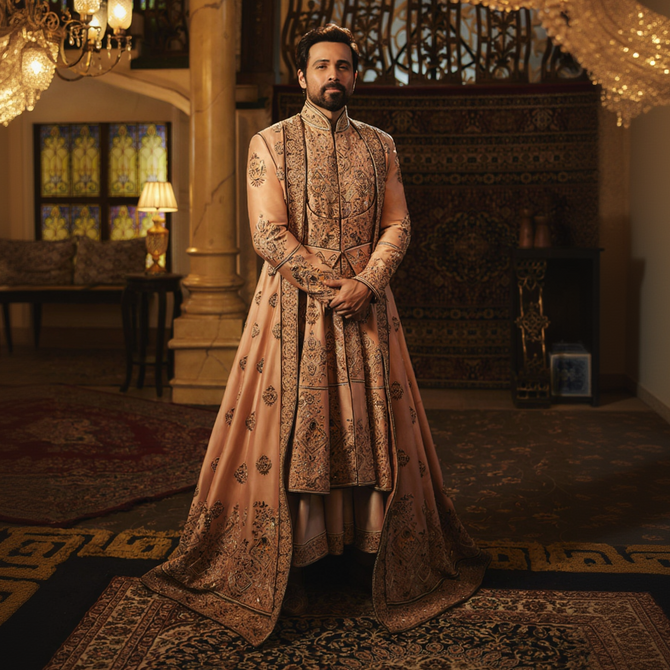

The Bandhgala is not a garment that survived by accident. It earned its place across generations of Indian fashion by doing something most silhouettes cannot manage, i.e., adapting without losing the quality that made it recognisable in the first place. Royal courts gave it its origins. Modern wardrobes gave it a second life. And somewhere between those two points, it became one of the most enduring forms of Indian formalwear in existence.
From Court Dress to a Distinctive Indian Silhouette
Strip the Bandhgala down to its essentials and the structure tells you everything. Closed front. High collar. A silhouette that communicates formality through proportion rather than ornamentation. These were not arbitrary design choices. They came out of the court dress traditions of Mughal and Rajput India, refined further through the influence of the Jodhpur court into jacket forms that could hold their own in the most formal settings imaginable.
The bandhgala suit for men today still carries that same underlying logic. Presence without excess. Authority through structure rather than decoration.
When Tradition Met Modern Tailoring
Jodhpur's royal connection with polo and international travel put the Bandhgala in rooms it had never been in before. European tailoring entered the picture, not to replace Indian design but to refine what was already there. Better construction methods, sharper fits, more considered finishing. The silhouette did not become Western. It became more precise.
That precision is what gave the designer bandhgala its staying power. The high collar stayed. The closed front stayed. But the garment around those defining details became something that could sit alongside the best contemporary suiting without feeling like it was apologising for its Indian origins. Designer bandhgala suits built on that foundation are still being made today for exactly that reason.
From Royal Status to Personal Identity
For a long time, the Bandhgala was defined by the people who wore it. Royalty. Diplomats. Men of a particular social standing. That changed gradually as the silhouette moved into public life and formal occasions beyond aristocratic circles, and with that shift came something more interesting than wider popularity.
The Bandhgala stopped being about status and started being about identity. A distinctly Indian approach to formal dressing that any man could claim as his own. Designer bandhgala suits stopped being symbols of inherited position and became expressions of personal style. That transition is what made the silhouette genuinely modern rather than simply old.
What Defines the Modern Bandhgala?
The modern bandhgala suit keeps the collar and the closed front. Everything else is open to interpretation.
Proportions have become sharper in some collections and more relaxed in others. Surfaces range from completely minimal to richly worked. A bandhgala jacket for men can anchor a formal wedding ensemble or carry a more understated evening look without the silhouette losing what makes it immediately identifiable. A designer bandhgala for men can be monochromatic and restrained or deeply embroidered depending entirely on who is wearing it and where.
That range is not a dilution of the silhouette. It is evidence that the Bandhgala belongs to more than one kind of occasion, more than one kind of groom, more than one kind of man.
The Bandhgala in Modern Luxury
Luxury does not always mean more. The luxury bandhgala for men today often earns its status through restraint, through proportion, through the way the garment has been built around a specific person rather than a standard template.
The wedding bandhgala for men is where this shows up most clearly. Richer colours, hand embroidery, and ceremonial details can all be introduced without the jacket's structure being lost beneath them. A designer wedding bandhgala can feel genuinely significant without reaching back into history to justify itself.
The Bandhgala has lasted because it never needed one era to define it. The best designer bandhgala suits are not reproductions. They are the silhouette, still moving forward, still belonging to whoever is wearing it now.
